Significant Figures Calculator (Sig Fig & Rounding)

A significant figures calculator counts and rounds digits that show measurement precision, using simple rules for zeros and standard rounding, and applies different rules for addition/subtraction versus multiplication/division.

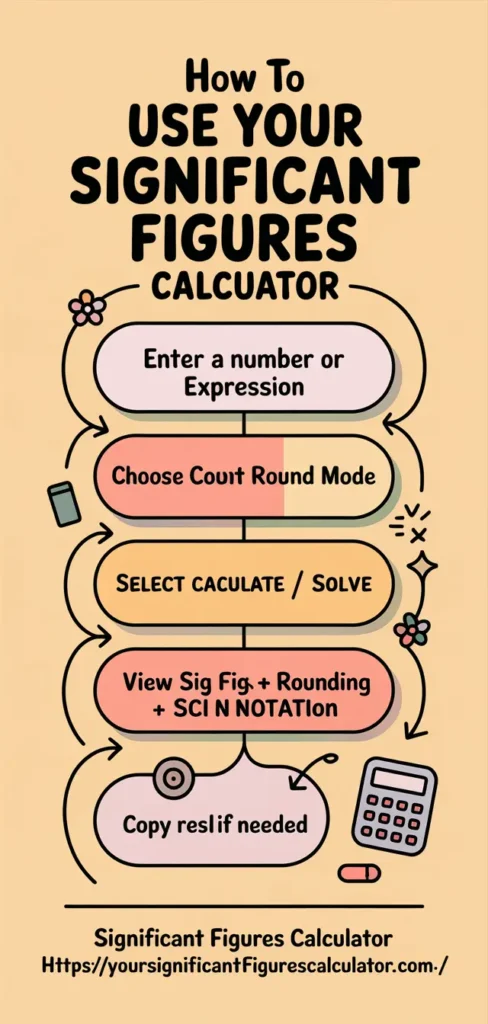
This calculator counts and rounds significant figures for any number or math line. Enter a value, pick a mode, and get the correct sig figs, rounded result, and scientific notation.

Type a number or an expression like 5.13*3.78, then press Calculate. The tool shows sig fig count, rounded value, and scientific notation.

Supports: + – * / ( ), scientific notation like 6.02e23.

Enter a value, choose count or round, then read the output blocks. The tool shows “Sig Fig Count,” “Rounded to N Sig Figs,” and “Scientific Notation.”

Pick Count or Round. Set N for rounding (e.g., 2, 3). This sig fig counter processes numbers instantly and shows the number of significant figures in each calculation.

How Many 
Significant Figures
Calculator?

Significant figures show how precise a number is. They include all sure digits plus one estimated digit.

Examples: 12.3 has 3 sig figs; 0.050 has 2 sig figs; 100.0 has 4 sig figs.

Sig figs (also called significant digits or scientific digits) represent measurement accuracy in science and math. These meaningful digits help scientists and students maintain precision across calculations and measurements.

Use simple rules to count sig figs in any number:

Scientific notation keeps all digits in the coefficient. Example: 4.00×10² → 3.00 sig figs

  • Non-zero digits count. Example: 357 → 3
  • Zeros between digits count. Example: 205 → 3
  • Leading zeros do not count. Example: 0.0012 → 2
  • Trailing zeros with a decimal count. Example: 2.500 → 4
  • Trailing zeros without a decimal are unclear. Example: 1500 → 2 to 4 (need context)

Count from the first non-zero digit and apply zero rules to the remaining digits. Start by identifying all non-zero digits, which are always significant. Check zeros between non-zero digits because these always count as significant. Ignore leading zeros since they never count toward the total. Count trailing zeros only if a decimal point exists in the number. This significant digit counter method applies to all numbers regardless of format. Find the first non-zero digit, then count all digits that meet significance rules. The process works for whole numbers, decimals, and scientific notation. Numbers like 0.00340 have 3 sig figs because the leading zeros don’t count but the trailing zero after the decimal does count. Use the significant figures calculator to verify your count instantly.

The number of sig figs depends on decimal points and zero placement. Understanding specific examples helps clarify the rules.

  • 100 has 1 significant figure because trailing zeros without a decimal point are ambiguous and don’t count. The number could represent anything from 50 to 150 rounded to the nearest hundred. Writing it as 100. with a decimal point would give it 3 sig figs, while 100.0 would have 4 sig figs.
  • 100.0 has 4 significant figures because the decimal point makes all trailing zeros significant. Each zero after the decimal tells you the measurement was precise to that place value.
  • 100.00 contains 5 significant figures due to the decimal point and two trailing zeros. This notation shows measurement precision to the hundredths place.
  • 1000 has 1 significant figure without a decimal point. Writing 1.000×10³ clearly shows 4 significant figures instead. Adding a decimal (1000.) would increase it to 4 sig figs.
  • 10.0 has 3 significant figures because the decimal point makes the trailing zero count. This shows measurement to the tenths place.
  • 2.00 has 3 sig figs because both trailing zeros after the decimal are significant. The number shows precision to the hundredths place.
  • 1.00 contains 3 significant figures due to two trailing zeros after the decimal point. Each zero indicates measurement precision.
  • 2.0 has 2 significant figures because one trailing zero after the decimal counts. The measurement is precise to the tenths place.
  • 20 has 1 significant figure because the trailing zero without a decimal is ambiguous. Writing 2.0×10¹ would show 2 sig figs clearly.
  • 0.01 has 1 significant figure because leading zeros never count. Only the digit 1 is significant.
  • 0.05 contains 1 significant figure since the leading zeros are placeholders. Only the 5 counts as significant.
  • 0.0060010 has 5 significant numbers. The leading zeros don’t count, but the digits 6, 0, 0, 1, and the final 0 after the decimal all count. The zeros between 6 and 1 are sandwiched between non-zero digits, making them significant. The final zero after 1 is a trailing zero after the decimal point, which counts.

Determine significant figures by applying zero rules and checking decimal placement. Check for decimal points because they affect trailing zeros. Identify zero positions as leading, sandwiched, or trailing. Use scientific notation when the coefficient shows all sig figs clearly.

Find significant digits by counting from the first non-zero digit to the last significant digit. The number 0.00340 has 3 significant digits when counting from 3 to the final 0. The number 5600 has 2 sig figs without a decimal but 4 sig figs when written as 5600. with a decimal point.

Determine by checking measurement precision and applying the five core zero rules. Non-zero digits always count. Zeros between non-zero digits count. Leading zeros never count. Trailing zeros count only with decimals. Scientific notation clarifies all significant digits in the coefficient.

Find them by marking the range from the first non-zero digit to the last significant position. This method works for any number format including standard notation, decimals, and scientific notation.

Rounding to Significant Figures (Mode)

Keep N digits from the first non-zero digit and round the next digit. If the next digit is 5–9, round up. If 0–4, keep.

Example: 2648 to 3 sig figs → 2.65×10³; to 2 sig figs → 2.6×10³. Example: 0.00674 to 2 sig figs → 0.0067.

Round from the first non-zero digit, count two places, then apply rounding rules. The number 233.356 rounded to 2 sig figs becomes 230 or 2.3×10². Start at the first non-zero digit (2), count two places (2 and 3), then check the next digit. Since 3 is less than 5, keep the second digit unchanged and replace remaining digits with zeros.

Count three digits from the first non-zero digit, then round based on the fourth digit. The number 2648 becomes 2650 or 2.65×10³ when rounded to 3 sig figs. Count 2, 6, and 4 as the three significant digits, then look at 8 (the next digit). Since 8 is greater than 5, round the 4 up to 5. Try rounding any number using our significant figures calculator for instant results.

0.03659 equals 0.0366 when rounded to 3 significant figures. Count from the first non-zero digit: 3, 6, and 5 are the three sig figs. The next digit is 9, which is greater than 5, so round the 5 up to 6.

Rounded sig figs maintain measurement precision by keeping only meaningful digits. Identify N (target sig figs), locate the (N+1)th digit, apply rounding rules, and adjust notation if needed. This rounding significant figures calculator method maintains precision standards across scientific work.

Significant Figures in Mathematical Operations

Use decimal places for +/− and sig figs for ×/÷.

Add/Subtract: Match the least decimal places. Example: 3.10 + 2.4 → 5.5.

Multiply/Divide: Match the least sig figs. Example: 1.6 × 2.4 → 3.8 (2 sig figs).

Mixed: Do each step, apply the rule at each stage.

Significant figures calculation applies operation-specific rules during mathematical expressions. The expression (4.56 × 2.1) + 3.21 first multiplies 4.56 and 2.1 to get 9.576, which rounds to 9.6 based on 2 sig figs from 2.1. Then adding 3.21 gives 12.81, which rounds to 12.8 based on decimal places. Each operation follows its specific rule before moving to the next step.

A calculating significant figures calculator handles mixed operations by applying rules sequentially. Addition and subtraction use the least number of decimal places from any input number. Multiplication and division use the least number of significant figures from any input number. Mixed expressions require step-by-step application of these rules at each operation. Yours Significant Figures Calculator to process complex expressions automatically.

Significant figures calculation follows operation-specific rules based on whether you add, subtract, multiply, or divide. Each mathematical operation has its own sig fig rule that determines the precision of the final answer.

Scientific Notation and Significant Figures

Scientific notation preserves the correct number of significant figures in the coefficient. Count only coefficient digits and ignore the exponent entirely.

The number 4.00×10² has 3 sig figs from the coefficient 4.00. The number 6.02×10²³ has 3 sig figs from the coefficient 6.02. The number 1.500×10⁻⁴ has 4 sig figs from the coefficient 1.500.

All digits in the coefficient are significant while the exponent only shows magnitude. The exponent (10²³ or 10⁻⁴) tells you the size of the number but doesn’t affect precision. A coefficient of 3.450 always has 4 sig figs whether multiplied by 10⁵ or 10⁻⁸.

Convert by counting coefficient digits only. The number 3.450×10⁵ equals 345,000 with 4 significant figures from the digits 3, 4, 5, and 0 in the coefficient. When writing large numbers in standard form, trailing zeros become ambiguous unless a decimal point appears

Calculating Sig Figs Step-by-Step

Calculate sig figs by identifying digit significance using the five standard rules. Write the number in standard or scientific notation. Mark the first non-zero digit as your start point. Mark the last significant digit as your end point. Count all digits between these points including any zeros that meet significance criteria.

Apply the 5 core rules for non-zero digits, sandwiched zeros, leading zeros, trailing zeros, and decimals. Every non-zero digit counts automatically. Zeros between non-zero digits always count. Leading zeros never count regardless of position. Trailing zeros count only when a decimal point exists. Scientific notation makes all coefficient digits significant.

Use decimal presence and zero position to figure out the total count. The number 0.004050 shows its first non-zero digit at 4 and its last significant digit at the trailing 0 after the decimal. This gives 4 sig figs from the digits 4, 0, 5, and 0.

Calculate by marking the range from first non-zero digit to last significant digit. Start counting at the leftmost non-zero digit, continue through all digits that meet significance rules, and stop at the rightmost significant digit. The process works identically for whole numbers, decimals, and scientific notation.

Use the least precise measurement in calculations to determine output precision. Addition and subtraction match the least number of decimal places from any input. Multiplication and division match the least number of sig figs from any input. Mixed operations require applying rules step-by-step as you work through the expression.

1 sig fig means keeping only the first non-zero digit. The number 7 has 1 sig fig naturally. The number 100 has 1 sig fig because trailing zeros without decimals don’t count. The number 0.009 has 1 sig fig because leading zeros never count. The number 6000 has 1 sig fig without decimal clarification.

Round to the first non-zero digit, then adjust based on the next digit. The number 4,582 rounds to 5,000 or 5×10³ with 1 sig fig. The number 0.0724 rounds to 0.07 or 7×10⁻² with 1 sig fig.

2 sig figs preserves two meaningful digits from the first non-zero digit. The number 45 has 2 sig figs naturally. The number 0.032 has 2 sig figs because leading zeros don’t count. The number 1500 typically has 2 sig figs without decimal context. The number 3.0 has 2 sig figs because the trailing zero after the decimal counts.

Keep two digits from the first non-zero position, then round the third digit. The number 4,582 rounds to 4,600 or 4.6×10³ with 2 sig figs. The number 0.07239 rounds to 0.072 with 2 sig figs. The rounding process maintains measurement precision at the two-digit level.

Three Significant Figures (3 Sig Figs)

3 sig figs keeps three meaningful digits from the first non-zero position. The number 456 has 3 sig figs naturally. The number 0.00340 has 3 sig figs from the digits 3, 4, and 0 after the decimal. The number 1.00 has 3 sig figs with both trailing zeros counting. The number 10.0 has 3 sig figs from 1, 0, and the trailing 0 after the decimal.

3.00 has 3 significant figures because trailing zeros after the decimal point always count. This notation shows measurement precision to the hundredths place. Other examples with 3.00 sig figs include 2.00, 5.00×10², and 0.00300.

Count three digits from the first non-zero position, then apply rounding rules to the fourth digit. The number 12,345 rounds to 12,300 or 1.23×10⁴ with 3 sig figs. The number 0.0012345 rounds to 0.00123 with 3 sig figs.

Enter any number, select “round to 3 sig figs,” and this calculator returns the properly rounded result. The tool automatically identifies the first non-zero digit, counts three positions, and applies correct rounding rules to produce accurate output.

Four Significant Figures (4 Sig Figs)

4 sig figs preserves four meaningful digits from the first non-zero position. The number 1,234 has 4 sig figs naturally. The number 0.001234 has 4 sig figs because leading zeros don’t count. The number 10.00 has 4 sig figs with trailing zeros after the decimal. The number 1.000×10⁵ has 4 sig figs from the coefficient.

Keep four digits from the first non-zero position, then round based on the fifth digit. The number 12,345 rounds to 12,350 or 1.235×10⁴ with 4 sig figs. The number 0.0012345 rounds to 0.001235 with 4 sig figs.

Supported Operators & Functions

Use +, −, ×, ÷, parentheses, and e notation. Examples: 12.01*3, 41.34+1.561+0.1334, 4.0e-2.

This scientific figures calculator and scientific digits calculator supports mathematical expressions for determining sig figs in calculated results.

Practical Examples & Use Cases

These sample inputs show common needs.

Count: 0.00208 → 3.

  • Round: 1047.78 to 3 sig figs → 1.05×10³.
  • Multiply: 0.0322*6.5 → 0.21 (2 sig figs).
  • Divide: 18.90/14 → 1.35 (3 sig figs).

Sig fig examples demonstrate how rules apply to different number types. The number 357 has 3 sig figs because all digits are non-zero. The number 0.0012 has 2 sig figs because leading zeros don’t count. The number 2.500 has 4 sig figs because trailing zeros after the decimal count.

Ambiguous numbers like 1500 have 2 sig figs without decimal context. Writing 1500. with a decimal gives 4 sig figs. Writing 1.500×10³ in scientific notation also clearly shows 4 sig figs.

Mixed zero patterns like 0.0060010 have 5 sig figs because sandwiched zeros and trailing zeros after decimals count. The number 100.0 has 4 sig figs because the decimal makes all zeros significant.

Sig Fig Counter and Converter

A sig fig counter automatically determines digit count by applying all significance rules. The tool examines zero positions, checks for decimal points, and identifies the range of significant digits. This significant digit counter processes any input format including whole numbers, decimals, scientific notation, and mathematical expressions.

A sig fig converter changes number format while preserving significant figures. Standard to scientific conversion changes 45,000 (2 sig figs) into 4.5×10⁴. Scientific to standard conversion changes 3.00×10² into 300.0 while preserving 3 sig figs.

Calculator Features and Tools

The number of significant figures calculator determines digit count automatically for any input. This online significant figure calculator processes total sig figs in single numbers, sig figs in complex expressions, and proper rounding levels for any precision requirement.

The number of significant digits represents measurement precision in scientific work. Count these digits using the five standard rules for zeros and decimal placement. This count determines how precisely a measurement or calculation result should be reported.

The number of sig figs in a value shows its measurement accuracy. Scientists and students use sig fig counts to maintain consistency across calculations and ensure results don’t claim false precision.

A significant calculator processes numbers according to precision rules. This Yours significant figures calculator provides automatic sig fig detection for inputs, operation-specific rules for mathematical expressions, scientific notation output for clarity, and accurate rounding at any precision level.

A significant digit counter identifies how many digits in a number are meaningful. The counter applies all five core rules automatically, handles scientific notation correctly, and works with any number format from simple integers to complex decimals.

A calculator with sig figs applies precision rules during all computations. Use this rounding significant figures calculator and round significant digits calculator for homework, lab work, and professional calculations in chemistry, physics, engineering, and mathematics.

Understanding Correct Significant Figures

The correct number of significant figures matches the least precise measurement in calculations. For a single number, apply zero rules based on decimal presence. For addition and subtraction, use the least number of decimal places from any input. For multiplication and division, use the least number of sig figs from any input.

Counting Significant Digits in Measurements

Counting significant digits in measurements requires applying zero rules and checking decimal awareness. The measurement 0.00340 g has 3 sig digits because leading zeros don’t count but the trailing zero after the decimal does. The measurement 25.0 mL has 3 sig digits because the trailing zero after the decimal counts. The measurement 1500 m has 2 sig digits because trailing zeros without a decimal are ambiguous. The measurement 0.0500 L has 3 sig digits from the digits 5, 0, and 0. The measurement 100.00 cm has 5 sig digits because all zeros after the decimal are significant.

Sigfigs and Sig Figures Terminology

Sigfigs and sig figures are shortened terms for significant figures. Both terms refer to the meaningful digits in a number that indicate measurement precision. Scientists, engineers, and students use these terms interchangeably when discussing measurement accuracy and calculation rules.

Conclusion

This Yourssignificant figures calculator (sig fig calculator) gives fast, correct counts and rounding for any number or expression. Enter a value, choose count or round, and get sig fig count, rounded value, and scientific notation that follow classroom and lab rules. Use this sig fig counter and significant digits calculator for homework, labs, and reports.

FAQS

When Do Zeros Count as Significant Figures?

Zeros between nonzero digits and trailing zeros with a decimal count; leading zeros do not count.

How do I Count Sig Figs in 0.002040?

0.002040 has 4 significant figures (2, 0, 4, and trailing 0 after decimal).

What Rule Do I Use for Addition and Subtraction with Sig Figs?

Match the least number of decimal places in the inputs.

What Rule Do I Use for Multiplication and Division with Sig Figs?

Match the least number of significant figures in the inputs.

How do I Round 2648 to three Significant Figures?

2648 rounds to 2.65×10³ (or 2650 in standard form).

How Many Significant Figures in 100, 100.0, and 100.00?

100 has 1, 100.0 has 4, and 100.00 has 5 significant figures.

Does Scientific Notation Change the Number of Significant Figures?

No; count only the digits in the coefficient (e.g., 4.00×10² has 3 sig figs).