
Significant Figures Calculator (Sig Fig & Rounding)
A significant figures calculator counts and rounds digits that show measurement precision, using simple rules for zeros and standard rounding, and applies different rules for addition/subtraction versus multiplication/division.
This calculator counts and rounds significant figures for any number or math line. Enter a value, pick a mode, and get the correct sig figs, rounded result, and scientific notation.
Significant Figures Calculator
Calculator Input (Enter Number or Expression)
Type a number or an expression like 5.13*3.78, then press Calculate. The tool shows sig fig count, rounded value, and scientific notation.
Supports: + – * / ( ), scientific notation like 6.02e23.

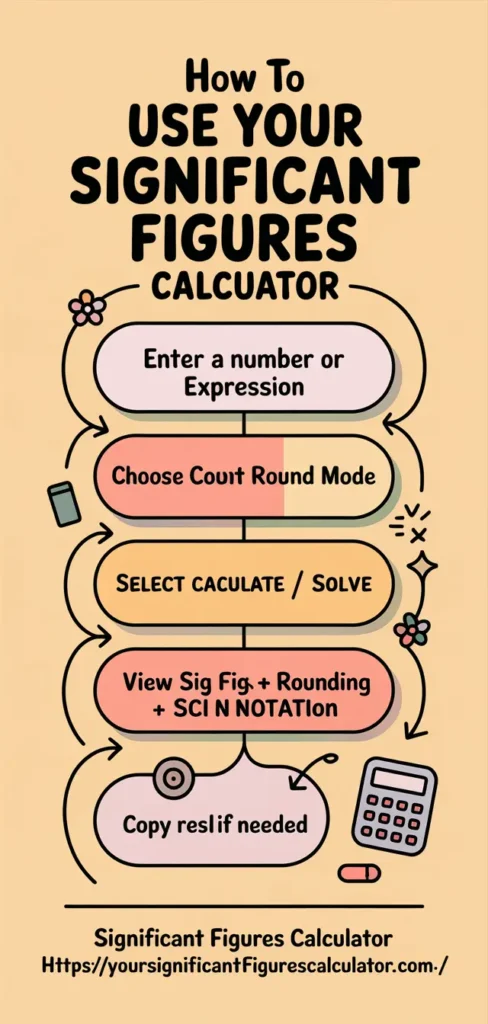
How to Use the Significant Figures Calculator
Enter a value, choose count or round, then read the output blocks. The tool shows “Sig Fig Count,” “Rounded to N Sig Figs,” and “Scientific Notation.”
- Set N for rounding (e.g., 2, 3).
- Pick Count or Round.
What are Significant Figures?
Significant figures show how precise a number is. They include all sure digits plus one estimated digit.
Examples:
12.3 has 3 sig figs; 0.050 has 2 sig figs; 100.0 has 4 sig figs.
How to Count Significant Figures (Rules & Method)
Use simple rules to count sig figs in any number.
Scientific notation keeps all digits in the coefficient. Example: 4.00×1024.00\times10^24.00×10² → 3.osit or WPS (Wage Protection System)
Non-zero digits count. Example: 357 → 3.
Zeros between digits count. Example: 205 → 3.
Leading zeros do not count. Example: 0.0012 → 2.
Trailing zeros with a decimal count. Example: 2.500 → 4.
Trailing zeros without a decimal are unclear. Example: 1500 → 2 to 4 (need context).
Rounding to Significant Figures (Mode)
Keep N digits from the first non-zero digit and round the next digit.
- If the next digit is 5–9, round up. If 0–4, keep.
- Example: 2648 to 3 sig figs → 2.65×10³; to 2 sig figs → 2.6×10³.
- Example: 0.00674 to 2 sig figs → 0.0067.
Significant Figures in Mathematical Operations
Use decimal places for +/− and sig figs for ×/÷.
Add/Subtract
Match the least decimal places. Example: 3.10 + 2.4 → 5.5.
Multiply/Divide
Match the least sig figs. Example: 1.6 × 2.4 → 3.8 (2 sig figs).
Mixed
Do each step, apply the rule at each stage
How Many Significant Figures? (Quick Guide)
Stop manually counting digits and second-guessing rounding rules.
Use this significant figures calculator to check precision, avoid mistakes, and focus on solving real problems.
Who Is This Calculator For?
Read patterns to count fast.
- Integers with dot: 100.0 → 4; 10.0 → 3.
- Decimals with leading zeros: 0.001 → 1; 0.050 → 2.
- With units: 2.00 g → 3; 100.10 in → 5.
Supported Operators & Functions
Use +, −, ×, ÷, parentheses, and e notation.
Examples: 12.01*3, 41.34+1.561+0.1334, 4.0e-2.
Examples & Use Cases
These sample inputs show common needs.
Divide: 18.90/14 → 1.35 (3 sig figs).
Count: 0.00208 → 3.
Round: 1047.78 to 3 sig figs → 1.05×10³.
Multiply: 0.0322*6.5 → 0.21 (2 sig figs).
| Rule Type | Significant? | Example | Explanation |
|---|---|---|---|
| Non-zero digits | Yes | 357 | All non-zero digits are always significant. |
| Leading zeros | No | 0.0045 | Zeros before the first non-zero digit do not count as significant figures. |
| Captive zeros | Yes | 1002 | Zeros between non-zero digits are always significant. |
| Trailing zeros | Sometimes | 2.50 | Trailing zeros are significant only if a decimal point is present. |
Common Examples: Counting Sig Figs in Different Numbers
This calculator is designed to follow standard academic and laboratory conventions.
This approach ensures accurate, defensible results for chemistry labs, physics problems, and scientific reports.
Methodology and Accuracy Standards
Our significant figures calculator prioritizes mathematical precision and scientific reliability.
Uses standard rounding conventions taught in universities
Supports round-to-even logic where applicable
Avoids premature rounding during intermediate steps
Treats exact values and defined constants correctly
FAQs
Calculate with Confidence, Every Time
Bookmark this sig fig calculator and use it whenever accuracy matters.
Trusted by students and professionals for chemistry labs, physics problems, and scientific calculations.