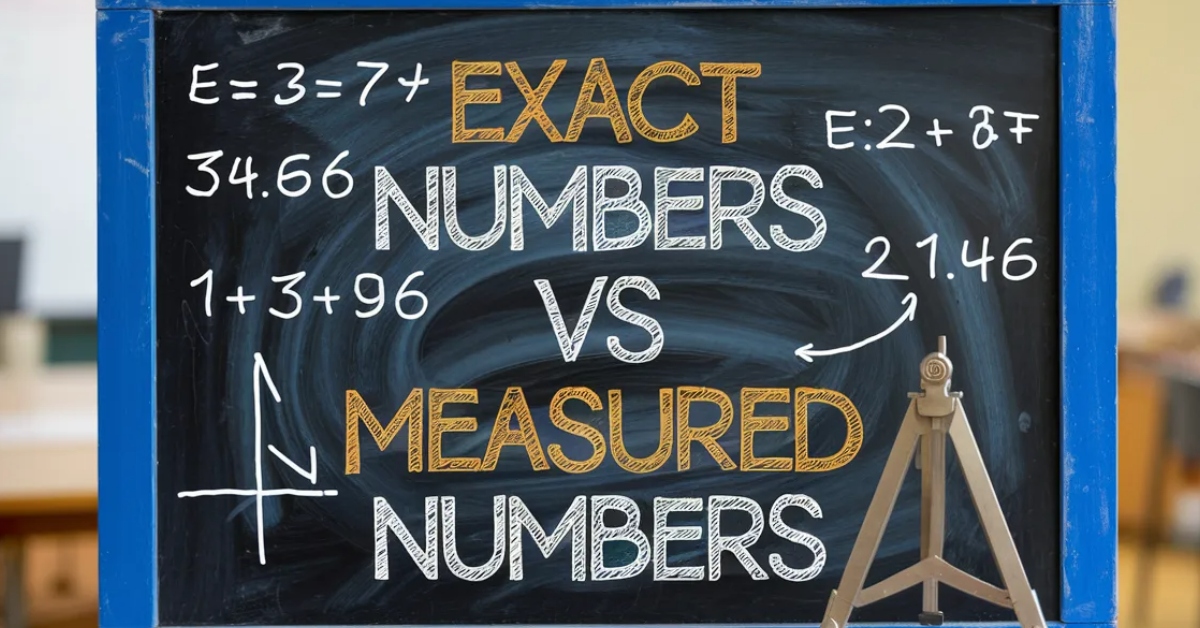
Exact Numbers vs Measured Numbers
Exact numbers are values we know with complete certainty like counting 10 fingers on your hands or knowing there are 12 inches in a foot. Measured numbers, on the other hand, come from tools like rulers, scales, and thermometers, and they always carry some level of uncertainty. That is the core difference between exact numbers and measured numbers, and it matters a lot more than you might think.
If you have ever worked through a chemistry lab or tried to figure out how significant figures work, this distinction probably came up. It changes how you round answers, how many significant figures you report, and whether your final result is trustworthy. In this article, we will break it all down what each type of number is, how to tell them apart, real examples of both, and why this knowledge is so important in science and math. We will also explain how exact and measured numbers connect to significant figures, uncertainty, and calculations you deal with every day.
Let’s get into it.
What Are Exact Numbers?
An exact number is a value that has zero doubt attached to it. There is no guessing involved. You know it perfectly, down to infinite decimal places if needed.
Exact numbers show up in two main ways:
Counting discrete objects. When you count things that cannot come in fractions, the result is exact. If you see 5 apples on a table, that number is 5.000000… and it goes on forever. There is no uncertainty. You did not use a measuring tool. You simply counted.
Defined values within measurement systems. Some numbers exist because humans decided they would be exactly that value. For example, there are exactly 100 centimeters in 1 meter. There are exactly 60 seconds in 1 minute. These are not measured they are defined.
Examples of Exact Numbers
Here are some common exact numbers you will see in science and everyday life:
- 12 eggs in a dozen
- 24 hours in a day
- 1000 milliliters in 1 liter
- 2.54 centimeters in 1 inch (this is defined, not measured)
- The number of students in a classroom (say, 28)
- 1 kilogram = 1000 grams
- 3 atoms of hydrogen in NH₃
That last example trips some people up. When a chemical formula says there are 3 hydrogen atoms in ammonia, that 3 is exact. It is not a measurement it comes from the molecular structure itself.
Why Exact Numbers Have Infinite Significant Figures
This is a big deal for calculations. Exact numbers are considered to have an infinite number of significant figures. Why? Because there is no last digit that involves a guess. Every digit is known with complete certainty, and you could keep writing zeros forever after the decimal point.
Think of it this way. If you have 4 people in a room, that number is 4.00000000… for as long as you want to write it. No rounding was involved. No instrument limited you.
This means exact numbers never limit the number of significant figures in your final answer. When you multiply a measured value by an exact number, you look only at the measured value to decide how many sig figs your answer should have.
For a deeper look at how these rules play out in real calculations, check out our guide on significant figures rules for multiplication and division.
What Are Measured Numbers?
A measured number is any value you get by using a measuring instrument — a ruler, a scale, a graduated cylinder, a thermometer, a stopwatch, or any other tool. Every single measured number carries some degree of uncertainty, because no measuring device is perfect.
Here is a simple way to think about it. Imagine measuring the length of a pencil with a ruler. The end of the pencil falls between the 7.6 cm and 7.7 cm marks. You estimate it looks like about 7.65 cm. That last digit the 5 is your best guess. It is uncertain. Another person might read it as 7.64 or 7.66.
That small doubt is built into every measurement. According to the National Institute of Standards and Technology (NIST), measurement uncertainty is the doubt about the true value that remains after a measurement is made. Even the most advanced scientific instruments in the world have some limit to their precision.
Examples of Measured Numbers
- The mass of a sample: 45.23 g (measured on a balance)
- The temperature of water: 98.6°F (measured with a thermometer)
- The length of a table: 152.4 cm (measured with a tape measure)
- The volume of a liquid: 25.0 mL (measured in a graduated cylinder)
- The time for a reaction: 3.45 seconds (measured with a stopwatch)
Every one of these values depends on the tool used. A more precise tool gives you more digits you can trust — but there is always a last digit that involves estimation.
Why Measured Numbers Have Limited Significant Figures
Because measured numbers involve uncertainty, they have a finite (limited) number of significant figures. The significant figures in a measured number tell you how precise that measurement is. The last significant digit is always the estimated one.
For example, if a balance reads 12.45 g, that measurement has 4 significant figures. The last digit (5) is the uncertain one the balance’s limit. If you had a more precise balance, you might read 12.453 g (5 significant figures), but even then, that last 3 is still an estimate.
This is exactly why significant figures exist to honestly communicate how much precision a measurement actually has. If you want to practice counting sig figs in different numbers, our sig fig calculator can help you check your work instantly.
Exact Numbers vs Measured Numbers: Side-by-Side Comparison
Sometimes the best way to see the difference is in a clear table. Here is a direct comparison:
| Feature | Exact Numbers | Measured Numbers |
|---|---|---|
| Source | Counting or definitions | Measuring instruments |
| Uncertainty | None (zero uncertainty) | Always present |
| Significant figures | Infinite | Finite (limited) |
| Examples | 12 inches = 1 foot, 7 chairs | 25.3 mL, 98.6°F, 4.56 g |
| Role in calculations | Never limit sig figs | Always limit sig figs |
| Can be expressed perfectly? | Yes | No always an approximation |
This table is worth studying if you are in a chemistry or physics class. The distinction between these two types of numbers shows up constantly in lab work and homework problems.
How to Identify Exact Numbers vs Measured Numbers
Students often struggle with this, so let’s walk through a simple decision process.
Ask Yourself Three Questions
1. Did someone count individual, whole items?
If yes, the number is exact. You counted 15 marbles, 3 books, or 42 students. No fractions or estimates involved.
2. Is the number part of a definition?
If yes, it is exact. There are exactly 100 centimeters in a meter. There are exactly 12 inches in a foot. These values were decided by humans, not discovered through measurement.
3. Was a measuring tool involved?
If someone used a ruler, a scale, a thermometer, a graduated cylinder, or any other instrument, the number is measured. It carries uncertainty.
Tricky Cases That Confuse People
Are counted numbers always exact? Yes — as long as you are counting whole, discrete objects. If you count 8 coins, that is exact. But if someone says “about 200 people attended the concert,” that 200 is an estimate, not an actual count of individuals. Context matters.
Are conversion factors always exact? Not all of them. Conversions within the same measurement system are usually exact. For example, 1 foot = 12 inches is exact. And 1 inch = 2.54 cm is also exact, because the inch was redefined based on the metric system back in the 1930s.
However, most conversions between the metric and English systems are measured, not exact. For instance, 1 pound = 453.6 grams is a measured approximation, not a definition. So you need to know the history behind the conversion to tell if it is exact or not.
What about constants like pi (π)? Pi is an exact mathematical constant — its value is what it is, with infinite digits. But in practice, when we write 3.14159, we are using a rounded version. Whether it limits your sig figs depends on how many digits of pi you use in a calculation versus how many sig figs your measured values have.
Why Measurements Are Never Truly Exact
This is a concept worth sitting with for a moment.
No matter how expensive your equipment is, no matter how careful you are, every measurement you take will have some degree of error. Scientists have accepted this for centuries. Here is why:
Instrument limitations. Every measuring tool has a smallest division. A ruler marked in millimeters cannot tell you the length to the nearest tenth of a millimeter. A balance that reads to 0.01 grams cannot tell you the mass to 0.001 grams. There is always a limit.
Human estimation. When a measurement falls between two marks, you have to estimate. Different people might estimate differently. This introduces random error — small variations that go in both directions.
Environmental factors. Temperature, humidity, air pressure, and vibration can all affect measurements. A metal ruler expands slightly in heat. A sensitive balance can be thrown off by air currents.
Systematic errors. Sometimes the instrument itself is slightly off. If a scale is not calibrated correctly, every reading will be consistently too high or too low. You might not even realize it.
All of these factors combine to create what scientists call measurement uncertainty. As NIST explains, this uncertainty is not a mistake it is an inherent part of the measurement process itself. It reflects the fact that we can never have perfect knowledge of a measured value.
This is also why significant figures exist. They are the scientific community’s way of saying, “Here is how much of this number we actually trust.”
How Exact and Measured Numbers Affect Significant Figures in Calculations
This is where the rubber meets the road. Understanding which numbers are exact and which are measured directly changes how you handle sig figs in math.
The Core Rule
When you do a calculation that involves both exact and measured numbers, only the measured numbers count when deciding the number of significant figures in your answer.
Here is an example. Say you measured the length of one side of a square tile as 10.5 inches. You want to find the perimeter, so you multiply by 4 (because a square has 4 sides).
- 10.5 inches × 4 = 42.0 inches
The number 4 is exact (you counted the sides). It has infinite significant figures. The number 10.5 has 3 significant figures. So your answer should also have 3 significant figures — which is why we write 42.0, not just 42.
If you mistakenly treated the 4 as a measured number with only 1 sig fig, you would round your answer to 40 inches — which would be wrong and would throw away precision you actually had.
Another Example From Chemistry
Suppose you need to convert 5.00 moles of water to molecules. You multiply by Avogadro’s number:
5.00 mol × 6.022 × 10²³ molecules/mol
The 5.00 here has 3 significant figures (it is measured). Avogadro’s number, as defined since 2019, is exactly 6.02214076 × 10²³. But in most textbook problems, it is treated as a defined constant. Your answer’s sig figs depend on the measured value (5.00), so you report the answer to 3 significant figures.
What About Addition and Subtraction?
The same principle applies. Exact numbers do not limit your decimal places. If you add 3 measured volumes in a graduated cylinder — say 12.5 mL + 13.2 mL + 11.8 mL — your answer depends on the decimal places of the measured values. The exact count of “3 measurements” does not factor in.
For more on how significant figures work across different operations, our article on significant figures vs decimal places goes deeper.
Exact and Measured Numbers in Chemistry: Real-World Applications
Chemistry is where this distinction comes alive. Nearly every calculation in a chemistry lab involves both exact and measured numbers working together.
Molar Mass Calculations
When you look up the atomic mass of carbon (12.011 g/mol), that value is measured — it comes from experimental data averaged across naturally occurring isotopes. But the subscripts in a chemical formula (like the 2 in H₂O) are exact. So when you calculate the molar mass of water:
- 2 × 1.008 g/mol (hydrogen) + 1 × 15.999 g/mol (oxygen) = 18.015 g/mol
The “2” and “1” are exact. The atomic masses are measured. Your final answer’s precision depends on those measured atomic masses.
Dilution and Solution Preparation
If a lab procedure says to dissolve a solute in “exactly 1 liter” of water, that 1 liter is a defined, exact value for the purpose of the calculation. But when you actually measure out that liter using a volumetric flask, the volume you get (say, 1.000 L) is a measured number with 4 significant figures.
Stoichiometry
Balanced equations use exact coefficients. In the reaction 2H₂ + O₂ → 2H₂O, the coefficients 2, 1, and 2 are all exact. The moles of reactants and products you measure in the lab are measured values. The exact coefficients never limit your sig figs — only the measured moles do.
Exact Numbers and Uncertainty: Clearing Up Confusion
Let’s address a misconception that trips up many students.
Do exact numbers have uncertainty?
No. By definition, exact numbers have zero uncertainty. When we say there are 12 inches in 1 foot, that 12 is absolutely, perfectly 12. Not 12.0001, not 11.9999 — it is 12, period. There is no error bar, no plus-or-minus, no range of possible values.
Do measured numbers always have uncertainty?
Yes, always. Even if you do not write a ± symbol, the uncertainty is there. The last digit of any measured number is always an estimate. A reading of 25.4 mL really means “somewhere around 25.3 to 25.5 mL,” depending on the precision of the instrument.
This is important because uncertainty propagates through calculations. When you multiply, divide, add, or subtract measured numbers, the uncertainty carries forward into your final answer. Exact numbers, because they have no uncertainty, do not add any extra doubt to your result.
Common Mistakes Students Make
We see these errors come up again and again. Here are the big ones:
Treating a counted number as measured. If a problem says “5 beakers of solution,” that 5 is exact. Do not let it limit your sig figs. Students sometimes see a small number like 5 and assume it has only 1 significant figure — but counted numbers have infinite sig figs.
Assuming all conversions are exact. As we discussed, conversions within a system (like metric-to-metric) are exact. But most metric-to-English conversions are measured. The key exception is 1 inch = 2.54 cm, which is exact by definition.
Forgetting that exact numbers have infinite sig figs. This leads students to round their answers too aggressively, losing precision they should have kept.
Confusing precision with accuracy. A measurement can be very precise (many significant figures) but not accurate (not close to the true value). Significant figures tell you about precision — how repeatable and detailed the measurement is — not whether it is correct.
If you want a fast way to double-check your significant figure counts in any number, try our sig fig calculator it handles all the tricky cases like trailing zeros and scientific notation automatically.
Exact Values vs Approximate Values: A Broader View
The concept of “exact vs measured” extends beyond science class. In everyday life, we deal with exact and approximate values all the time — we just do not always think about it.
Your age in years is exact (you have had a specific number of birthdays). But your weight this morning? That is measured and approximate — it depends on the scale you used and when you stepped on it.
The speed limit on a highway (say, 65 mph) is an exact, defined value. But your car’s speedometer reading at any given moment is a measured approximation — speedometers have their own margin of error.
In math, numbers like 1/3 or √2 are exact, even though their decimal representations go on forever (0.33333… and 1.41421…). They are perfectly defined mathematical quantities. But the moment you write 0.333 or 1.414 as a rounded version, you have introduced approximation.
Understanding this broader idea helps you appreciate why scientists are so careful about distinguishing exact from measured values. It is not about being picky — it is about being honest with data.
FAQs
What are exact numbers in math?
Exact numbers are values known with complete certainty. They come from counting whole objects (like 7 chairs) or from definitions (like 100 cm in 1 meter). They have no uncertainty and are considered to have infinite significant figures.
What are measured numbers in math?
Measured numbers are values obtained using a measuring instrument, such as a ruler, scale, or thermometer. They always carry some uncertainty because no tool is perfectly precise. The last digit in a measured number is always an estimate.
Are counted numbers exact or measured?
Counted numbers are exact, as long as you are counting whole, individual objects. If you count 12 chairs in a room, that 12 is exact. However, an estimated count (like “about 500 people”) is not exact because it was not a precise count.
Are conversion factors exact numbers?
It depends on the conversion. Conversions within the same system (like 1 km = 1000 m or 1 ft = 12 in) are exact because they are defined. Most cross-system conversions (like pounds to kilograms) are measured and not exact. One notable exception is 1 inch = 2.54 cm, which is exact by definition.
Do exact numbers have significant figures?
Yes exact numbers are considered to have an infinite number of significant figures. Because every digit is known with certainty, there is no estimated digit that would limit your answer’s precision.
Do measured numbers have significant figures?
Yes. Measured numbers have a finite number of significant figures determined by the precision of the measuring tool. The more precise the instrument, the more significant figures the measurement will have.
How do exact numbers affect significant figures in calculations?
Exact numbers never limit the number of significant figures in your final answer. When you multiply or divide a measured value by an exact number, only the measured value’s sig figs determine how many sig figs the answer should have.
Why are measurements never truly exact?
Measurements are never exact because every measuring tool has a limit to its precision, humans must estimate between scale marks, and environmental factors (temperature, vibration, humidity) can affect readings. There is always some uncertainty present.
How can I identify whether a number is exact or measured?
Ask three questions: Was it counted (whole objects)? Is it a defined value (within a measurement system)? Or was a measuring tool involved? Counted and defined values are exact. Anything involving a measuring instrument is measured.
What is the difference between exact values and approximate values?
Exact values are known with perfect certainty (like 12 inches in a foot or the number of sides on a triangle). Approximate values are close to the true value but not perfectly known, usually because they were measured or rounded. All measured numbers are approximate values.
Final Thoughts
The difference between exact numbers and measured numbers is one of those foundational concepts that makes everything else in science and math click into place. Exact numbers — from counting or definitions — are perfectly known and carry infinite significant figures. Measured numbers come from instruments, always carry uncertainty, and have a limited number of significant figures that reflect the tool’s precision.
Getting this right matters. It determines how you handle significant figures in scientific notation, how you round answers in chemistry problems, and how honestly you report your lab data. Every time you do a calculation with both types of numbers, remembering this distinction keeps your work accurate and trustworthy.
If you are working through problems right now and want a quick way to verify your sig fig counts, rounding, or calculations, give our significant figures calculator a try. It applies all the standard rules automatically and shows you step-by-step logic so you can focus on understanding the science, not second-guessing the math.